The Freedom To Think Not Much At All
“People who once lived under the yoke of oppressive religion now have the freedom to believe, read, and do what they want. So why have the ungrateful bastards not become full-fledged atheists? The answer from some quarters seems to be that not all have got the message, so what they need is some reeducation in the folly of religion and the joys of science. But this is wrong. The reason they haven’t become atheists is that many people use the freedom to think what they want to not think very much at all. And, given the evidence of history, I don’t think that a population without strong convictions on matters of fundamental ideology is a bad thing.”
From “Toward a More Mannerly Secularism”, by Julian Baggini
(Doesn’t seem to be online, unfortunately - can be found in print in the Feb/Mar 2007 issue of Free Inquiry.)
Baggini makes a compelling argument that uncompromising atheists like Richard Dawkins are sabotaging their own efforts by framing the discussion as a fierce battle of us-vs-them. Us, the reasonable, science-loving atheists; and them, the superstitious, unreasonable theists. But most people would rather ignore both science and religion, while not directly disassociating themselves from either. Perhaps the best way for outdated beliefs to exit our cultural consciousness is to wither away; direct frontal assault will only reawaken fervent faith.
Opportunties
“It’s always possible to find a reason to stay put, to skip an opportunity, or to decline an offer. And yet, in retrospect, it’s hard to remember why we said no and easy to wish that we had said yes.”
From Seth Godin’s Time to take action
His post is about business, but to me this point is just as important for life in general.
Omit Needless Laws
“The Lord’s Prayer contains 56 words; the Gettysburg Address, 266; the Ten Commandments, 297; the Declaration of Independence, 300; and a recent US government order setting the price of cabbage, 26,911.
At the state level, over 250,000 bills are introduced each year. And 25,000 pass the legislatures to disappear into the labyrinths of the law.
Ignorance of the law is no excuse. Ignorance of lawmakers apparently is. Our legislators continue to pass thousands of laws that you can’t possibly keep track of. And even if you could, you couldn’t possibly remember how a law might differ from one of our 50 states to another.”
From Positioning: The Battle For Your Mind by Al Ries and Jack Trout
Accurate Directions
While typing in my zipcode to get directions on Google Maps, I accidentally left off the last digit. Apparently, this is a postal code in Belgium, and without the slightest hesitation Google Maps dutifully served up exact turn-by-turn directions between there and here. Step 24 had me quite amused:
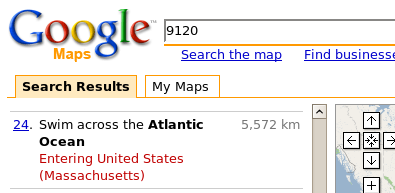
They were even thoughtful enough to put the distances in kilometers, what with me starting my trip in Europe.
The Mind of God
Yesterday I was listening to an audio book (that’s what we called podcasts in the olden days) on the subject of natural law. The lecturer, a Jesuit priest, noted that many theologians conjecture that the existence of moral obligations implies the existence of a god. After all, obligation can only exist if you’re obliged to a certain party. That party can only be a divine creator, by their reasoning.
The counterargument to this is so obvious as to be hardly worth stating, but I’ll do it anyway: you’re obliged to society as a whole, or at least the part of it that will be impacted by your actions. For example, a person’s obligation not to steal is an obligation not only the person or people who own that property, but also their friends and family, who will feel secondary effects of the harm done.
Moreover, all of society is harmed whenever theft occurs: it makes people less secure about their property. That in turn means that owners will spend more time looking for ways to protect their property, and less time putting that property to use in creating happiness and wealth for themselves and the world. Defacing a park hurts everyone, because now the park owner(s) are going to think about putting up fences and hanging signs, instead of planting more flowers.
Still, the morals-imply-god argument got me thinking. Maybe the sum total of human consciousness - the hive mind that I suggested in Elephants All The Way Up - is what believers really mean when they use the word “god.” Think of the primary traits of the Christian god: a vast intelligence, as old as humanity itself, everywhere that humans are (but at the same time nowhere specific), an entity that loves and understands humankind deeply and purely. All of those things describe the sum of human consciousness. The mind of God is an emergent effect of the decentralized network of humans on planet Earth. We’re each a neuron in God’s brain.
Read more »
Ayn’s Vision
Many people see Ayn Rand as a symbol of libertarianism. For some libertarians, she’s a hero. For many libertarian detractors, she’s the perfect target: a heroine of libertarian thought, but also a total nutjob.
She’s never really been a hero for me, but I certainly acknowledge that she was the visionary who spurred the revolution of libertarian thought in the middle of the last century. I think “visionary” is a term worth inspecting here. Normally it’s used in a positive sense, but the first definition which appears in my dictionary is “given to or characterized by fanciful, not presently workable, or unpractical ideas, views, or schemes.” Hardly praise, put that way.
Visionaries are people who take out-of-the-box thinking to an extreme. They imagine possibilities far beyond what normal creativity would produce. Most of the time they are ignored, because their ideas are flights of fantasy with no connection to reality. But sometimes, the vision is a useful one: something distant, yes, but theoretically achievable. Something that hints at a grand long-term solution to a current and seemingly intractable problems of life, business, or culture.
Read more »