Authors
“When I read a novel that I really like, I feel as if I am in direct, personal communication with the author. I feel as if the author and I are on the same wavelength mentally, that we have a lot in common with each other, and that we could have an interesting conversation, or even a friendship, if the circumstances permitted it. When the novel comes to an end, I feel a certain letdown, a loss of contact. It is natural to want to recapture that feeling by reading other works by the same author, or by corresponding with him/her directly.
[…]
A novel represents years of hard work distilled into a few hundred pages, with all (or at least most) of the bad ideas cut out and thrown away, and the good ideas polished and refined as much as possible. Interacting with an author in person is nothing like reading his novels. Just about everyone who gets an opportunity to meet with an author in person ends up feeling mildly let down, and in some cases, grievously disappointed.”
From Why I am a Bad Correspondent by Neal Stephenson
Vicky Cristina Barcelona
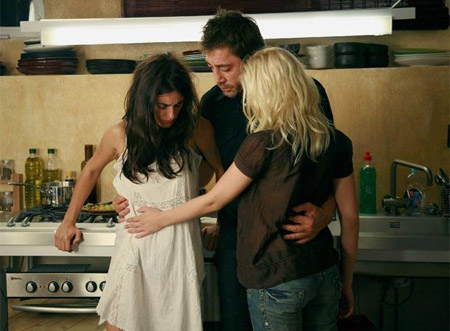
Saw Vicky Cristina Barcelona the other night, and really enjoyed it. As for the polyamory themes it contains, Lauren Wissot sums it up nicely:
“Not only is [Woody Allen’s] latest celluloid psychotherapy session Vicky Cristina Barcelona a phenomenal work of intellectual porn, but it also happens to contain one of the sexiest, most hysterical and poignant portrayals of polyamory to come along in a long, long time. Allen actually gets that those of us who choose to live outside of hetero monogamy are not voracious sex addicts lacking in morality – on the contrary, we simply abide by a different set of desires and ethics than that of the mainstream.”
Some heartwarming stills:

My Creative Beast
“My creative beast is restless and hungry, and I’ve learned that if I starve it by arbitrarily limiting its routine, it’s not happy. It’s all well and good to cut the fat out of your life to make time for what’s important, but you can take it too far. By turning off the internet, I turned off my source of inspiration. I was trying to write in a vacuum.
From Cooking for the Creative Beast by Matt Wood
Cogs
Steampunk chat abbreviations. My favorites:
| -_Q | Monocle. |
| -O=O- | Goggles. |
| BTC | By the cogs! |
| WATT | What’s all this then? |
I’m totally going to slip “By the cogs!” in my next conversation.
Producers of Structured Indolence
“There is also the question of competitive advantage. Most nations gain their advantage by making things more efficiently, and at lower cost, than their competitors.
To the extent that the French enjoy a natural advantage, it is in their inefficiency: They are the world’s most efficient producers of structured indolence. They are the kept women of the global economy; their status depends, in part, on their practical uselessness.”
Having just gotten back from a week in France, I can wholeheartedly confirm this. The quote is from the extremely enteratining Sarkozy Forces the French to Join the 1980s by Michael Lewis (by way of Megan McArdle).
Plagiarism
Plagiarism is a serious accusation. We’re taught this from an early age - copying an encyclopedia entry for your report on Zimbabwe, for example, is about as grave a crime as a 3rd grader can commit. Cultural episodes like the Milli Vanilli scandal reinforce this at an adult level: that using some part of someone else’s creative work in your own is so vile an act that it might drive someone to suicide.
But like many seemingly black-and-white moral issues, advances in technology reveal gray areas. An age of highly fluid and editable media has produced the phenomenon of the creative remix. Where is the line drawn between creative remixing and plagiarism?
Is Weezer’s video, which is mostly made up of footage from various YouTube videos, a creative remix or plagiarism? How about all those Google Maps mashups, most of which get all their content from Google Maps? What about a DJ, who usually plays nearly 100% music written by other people?
One of my recent posts was copied in its entirety and reposted to what appears to be some sort of accounting-oriented linkspam site. They do provide a link back to the original article, though my name appears nowhere on the page. Is this plagiarism? By most conventional definitions, I’d say yes.
But I’m not upset. My personal feeling is that plagiarism is not the big deal that most people make out of it. I’ve had my creative material copied without being asked my permission or being given attribution on the resulting work a few times in the past, usually music. For some reason it just doesn’t bother me. If anything, I feel flattered that they find my work worthy of copying.
But, there is always a moment of disorientation and slight discomfort when I stumble across it. It’s like looking at a distorted image that looks strangely familiar, and moments later realizing that it is your own face being reflected back from a funhouse mirror. I can see how some, in that moment, might escalate that feeling into hurt, betrayal, and anger.
Death To Stuff, Part 2
Some other perspectives on stuff.
Merlinn Man tackles the topic:
“Ours is a culture based on the idea that whenever you run out of space, you should just pull up stakes and move five miles west. Then you can be happy. Is it any wonder that we seek organization rather than deletion as the solution to an overwhelming problem?”
Three cheers for deletion.
Paul Graham weighs in:
“Humans constantly scan their environment to build a mental model of what’s around them. And the harder a scene is to parse, the less energy you have left for conscious thoughts. A cluttered room is literally exhausting.”
Three cheers for minimalist decor - and closets and drawers, for hiding away the clutter.